



When choosing between piston‑type compressors and diaphragm compressors, there is often debate over which is better. While manufacturers of oil‑free piston compressors claim their products are superior, diaphragm compressor manufacturers argue that their technology offers a better solution. The reality, however, is that there is no clear‑cut answer.
The right selection depends on a range of factors, including: ‑ The gas to be compressed; ‑ Required operating pressure; ‑ Required volumetric capacity; ‑ Clean‑liness requirements for the compressed gas (acceptability of oil / oil vapor).
In this article, we will take an in‑depth look at these factors to help you determine which compressor is best suited for your requirements.
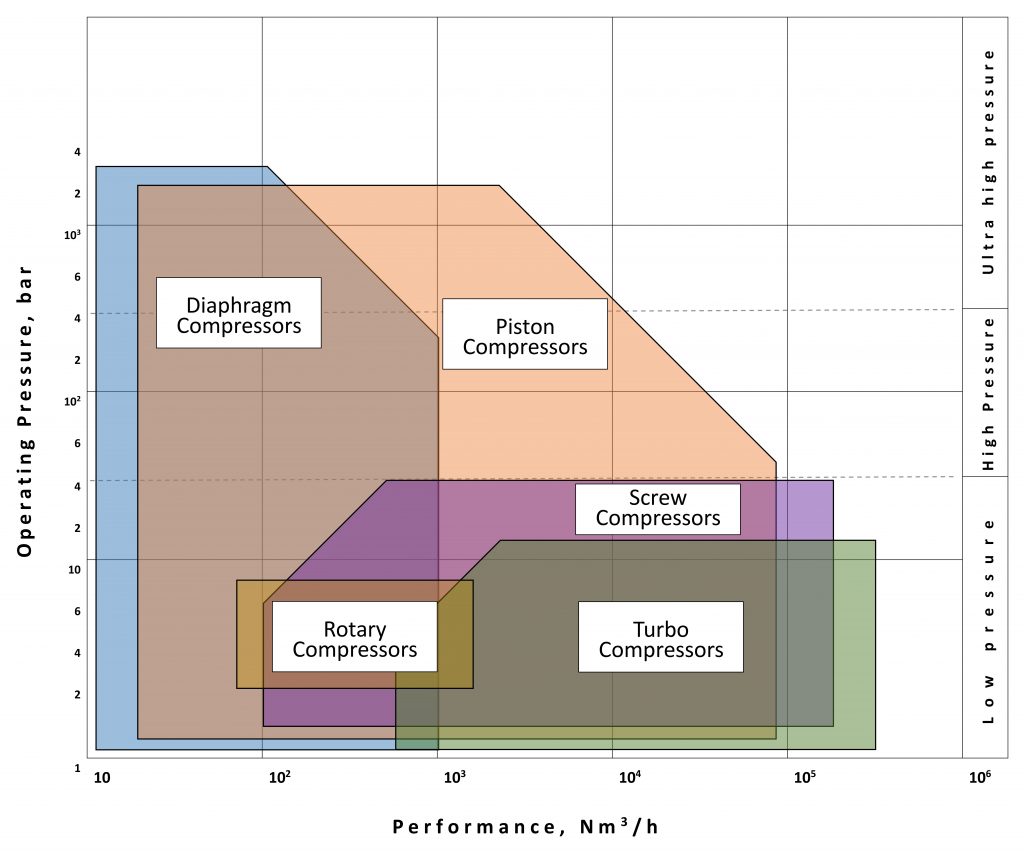
The figure above shows that a wide range of capacities and operating pressures can be covered. Nevertheless, piston‑type compressors are the preferred choice for high operating pressures above 15 bar and high‑capacity applications above 15 bar, whereas diaphragm compressors represent the only option for certain higher operating pressures. The overlapping area in the diagram of Fig. 1 indicates the range where both types are applicable, and more specific selection factors come into play within this zone.
The main similarity between diaphragm compressors and piston‑type compressors is that both feature an oil‑filled crankcase housing the crank‑linkage mechanism (CKM). In addition, the number of rods and pistons in both compressors corresponds to the number of compression stages of the compressor. Apart from these common features, however, the two compressor types differ in design and operation. Their further differences are summarized in the table below.
| Characteristic | Piston Compressor | Diaphragm Compressor |
| Compressed Gas | Due to the materials used in its structure, it is suitable for compressing a limited range of gases. The specific list of compressible gases depends on the materials of the piston, piston rings, cylinder and other components. | It can compress almost any gas without restriction. Because the compressed gas only contacts high-quality, corrosion-resistant steel parts. |
| Drive Type | Piston compressors can be belt-driven, or directly driven by couplings with elastic elements. | Diaphragm compressors are usually belt-driven, and direct drive is rare. |
| Rotational Speed | The speed varies, but vibration of the compressor increases at higher speeds. Therefore, vibration isolation mounts must be installed when placing it on the foundation. | Their speed is usually low, generally up to 500 rpm. The low speed results in low vibration during operation, so no vibration isolation is required when installing the compressor on the foundation. |
| Stage Pressure Ratio (ratio of suction pressure to discharge pressure per compressor stage) | As a general rule, the stage pressure ratio of piston compressors is limited to no more than 1:8. A higher ratio may cause overheating of the compression stage. | The stage pressure ratio of diaphragm compressors is usually greater than 1:15. This high compression ratio enables the compressor to achieve high outlet pressure with fewer stages than piston compressors. |
| Cooling | Piston compressors can be air-cooled or water-cooled. Air-cooled compressors generate considerable noise from the operating fan, and hot air in the room needs to be removed. The cylinders of air-cooled compressors usually have fins, which makes the design more complex and expensive. In contrast, water-cooled compressors use water as the cooling medium and are generally quieter than air-cooled ones. | Diaphragm compressors are usually water-cooled; in some cases, combined cooling can be used. It uses an additional pump to circulate coolant in a closed circuit and cool the liquid in a radiator blown by a fan. However, this cooling system has the disadvantages of traditional air cooling. In addition, the combined cooling system may be expensive due to the use of additional pumps and radiators. |
| Contact Between Compressed Gas and Oil | Contact between compressible gas and oil exists in oil-lubricated piston compressors. This limits their use for compressing clean gases due to the risk of oil contamination. However, in oil-free compressors, there is no contact between gas and oil because piston rings or shaft packing prevent oil from entering the compression chamber. But if the rings that separate the compression chamber from the oil circuit wear out, there is a risk of oil vapor or ingress. In this case, there is no emergency protection to prevent oil entry, which may lead to contamination of the compressed gas. | Due to the use of a three-layer diaphragm, the compressible gas of the diaphragm compressor does not contact with oil. This design ensures complete separation of oil and gas, and even if one of the diaphragms ruptures, it will cause the compressor to stop immediately in an emergency. Therefore, diaphragm compressors are suitable for compressing various gases without any restrictions due to contact with oil. |
| Lubrication of Friction Parts | The friction parts of piston compressors are usually lubricated by splash lubrication or forced lubrication. In crosshead compressors, a special device called a lubricator is required to lubricate the piston and cylinder. It is crucial to monitor the operation of these devices and adjust them correctly, because the failure of the lubricator will lead to catastrophic consequences such as seizure. In oil-free compressors, the cylinder and piston do not need lubrication. However, they require unique materials and a more complex cooling system to ensure normal operation. | The parts of the crankcase are lubricated by splash or forced lubrication. Gas compression is achieved by the movement of the diaphragm, which separates the hydraulic oil from the compressed gas. Hydraulic oil is the medium that transmits pressure from the drive mechanism to the diaphragm. This design eliminates the need for lubrication of gas compression parts, as there is no direct contact between the gas and any friction parts. |
| Feasibility of Immediate Adjustment of Discharge Pressure for Each Stage | Not available. | Diaphragm compressors allow the final compression pressure of each stage to be adjusted using a hydraulic bypass valve. The compression characteristics of the compressor can be changed easily and quickly on site. |
| Sealing Performance | The compression chamber (cylinder) of the piston compressor is sealed with static (gaskets, etc.) and dynamic (gland packing, etc.) seals to ensure tightness. However, dynamic seals are susceptible to mechanical wear, so their condition needs to be monitored regularly. | In diaphragm compressors, the tightness of the compression chamber is only maintained by static seals. There are no dynamic seals as in piston compressors, so there is no mechanical wear. |
| Ease of Maintenance | The maintenance of piston compressors may be complex and time-consuming, depending on the design and number of compression stages. Single-acting and double-acting compressors may require different maintenance procedures, and additional equipment such as lubricators also affects the maintenance process. Special equipment and tools may be required, and only qualified personnel can perform maintenance to ensure normal operation and prevent damage to the compressor. | The maintenance of diaphragm compressors is relatively simple, and does not require special equipment or highly skilled technicians. The compressor has a simple and user-friendly design, so parts such as diaphragms and seals can be replaced directly. |
This additional information is also essential for your selection.
Diaphragm compressors are well‑suited for compressing clean / ultra‑pure / toxic gases, where even the slightest contact with oil vapor inside the compression chamber is unacceptable.
Diaphragm compressors can handle any inlet pressure, while piston‑type compressors have limitations in this respect.
For diaphragm compressors, the gas to be compressed must be dry and moisture‑free to prevent accelerated wear and premature failure.
Diaphragm compressors are larger and more costly than reciprocating compressors of comparable characteristics.
Diaphragm compressors are recommended for compressing expensive, rare and pure gases, so as to avoid substantial losses caused by contaminants and oil vapor.
 |
TELEPHONE |
 |
Address:No.18 Kaixuan Street, ,Jianshe Road, Liangxiang, Fangshan District, Beijing,China |
 |
Email:info@taneor.com |
 |
Tel:(+86)13601381607 |

